

07 Aug, 2026
Heartworm Screening in Dogs: The Secrets to Success
Lindsay Starkey, DVM, PhD, DACVM-Parasitology
Associate Professor of Parasitology, Oklahoma State University
The American Heartworm Society (AHS) recently conducted a survey of U.S. veterinarians about their heartworm management practices, including how they prevent, diagnose and treat heartworms in their patients. In this survey, participating veterinarians reported that just under three-quarters (72%) of their canine patients are screened annually for heartworm. This percentage was slightly higher in the southern and northeastern states (78 and 79%, respectively), but significantly lower in the western U.S., where only 58% of dogs are screened.
At the same time, most veterinarians (94%) told us they recommend heartworm prevention for dogs, with most advocating year-round administration. While our data did not tell us whether the gap between screening and prevention practices is due to client refusal to have their dogs tested, veterinary hesitancy to recommend it or some other reason, it’s clear that significant numbers of dogs under veterinary care are not undergoing routine testing for heartworm infection.
Heartworm screening: What does the AHS recommend—and why?
Here’s a quick review: The American Heartworm Society (AHS) Canine Guidelines recommend that all dogs over the age of 7 months, including healthy dogs, be tested annually for evidence of heartworm infection. Since 2016, the recommended canine heartworm screening protocol has included both antigen and microfilaria testing for every dog.
Here’s why: Routine annual screening enables the veterinarian to detect heartworm infection early, before overt clinical signs of infection are present. It also allows veterinarians to initiate early treatment and ensure that heartworm prevention is given routinely and on time in the future. Once a dog becomes infected with heartworms, damage occurs with every beat of the animal’s heart. Waiting until dogs are symptomatic to test them increases the likelihood of long-term cardiovascular damage, even if dogs ultimately undergo treatment to eliminate adult heartworms. And the longer a diagnosis is delayed, the greater the risk of long-term or permanent damage.
Meanwhile, the purpose of including both antigen (Ag) and microfilaria (MF) testing as part of the screening process is to ensure that heartworm diagnoses aren’t inadvertently missed. False-negative Ag results do occasionally occur because of unpredictable immune-system interference; by including a concurrent MF test, we give ourselves an alternative means for detection, lessening the overall chance that an infected dog will go undiagnosed.
When heartworm screening results are confusing: what next?
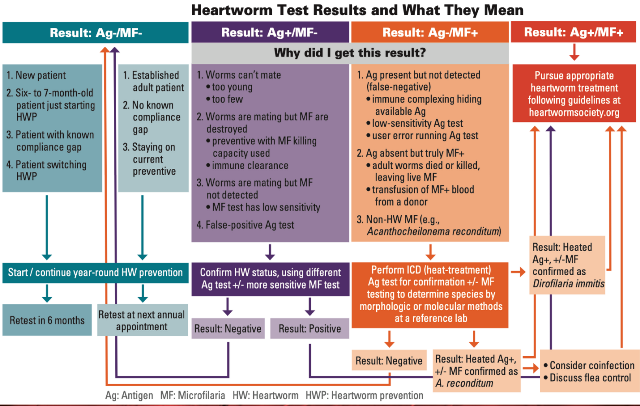
While interpreting Ag and MF test results is typically straightforward, discordant results can occur.
One example is a microfilaremic dog that has no detectable heartworm antigen. This can be caused by an immune complex that blocks the heartworm antigen and yields a false-negative test result. Another example is an antigen-positive dog where microfilaria are not detected. This can occur when there aren’t enough adult worms to procreate, if the male and female worms are not in proximity to each other in the pulmonary vascular system, or if an insensitive MF test was used that failed to detect a low-level infection. Still another possibility is that the animal’s immune system or intermittent use of certain heartworm preventive medications have helped clear the microfilaria stages but not the other life stages of the heartworms.
The bottom line: heartworm testing can reveal that dogs are Ag+/MF+, Ag-/MF- or be positive for one and negative for the other. To help navigate discordant results on screening tests, use the algorithm below for guidance.
Overcoming client resistance to annual heartworm screening
The cost of heartworm screening can sometimes be a barrier to screening compliance. Clients may also push back on the veterinarian’s recommendations for annual testing because they perceive their pets are not really at risk—either because of low exposure due to locale or the pet’s lifestyle—or because the dog is on prevention and theoretically should not be infected.
While it’s understandable that owners might sometimes question why their apparently healthy dogs should be tested for heartworms if they have been on year-round prevention, veterinarians can emphasize the following points:
- Preventive compliance lapses can occur despite owners’ best intentions, with such lapses inadvertently resulting in infection.
- Even if preventives are administered properly, other factors can lead to so-called medication “failure.” Most common among these are animal-related factors, such as the dog spitting out an oral medication when the owner isn’t looking or a topical medication being rubbed or rinsed off.
- Less common, but real, is the possibility that a dog on prevention has become infected because they were bitten by a mosquito carrying resistant heartworms.
Heartworm screening: beyond the annual test
While annual heartworm screening is the typical scenario for most dogs, there are exceptions:
Puppies. While puppies should be started on heartworm prevention as early as 4 weeks of age (depending on the product label), there is no value in antigen testing dogs younger than 7 months of age. The prepatent period is the six-month lag time between when the dog is infected with heartworms and when the parasites reach the stage of their life cycle when heartworm antigen exists in substantial enough amounts to be detected with an antigen test. To ensure that an early infection was not missed at the time of the initial test, a second heartworm screening is advised at one year of age.
Dogs with unknown health history or a history of interrupted heartworm prevention. At the AHS, we frequently field questions from owners who have adopted rescue dogs that had no antigen detected on a heartworm test at the time of adoption, then months later found to be positive for heartworm. Again, the lag time between infection and diagnosis is the typical reason. If a dog was infected less than six months before the initial screening, heartworm testing will likely indicate the animal is negative for both Ag and MF. For this reason, the AHS recommends follow-up screening six months after the initial screening in cases where the dog’s prevention history is unknown. If the second test is negative, the patient can be moved to an annual screening schedule.
While heartworm testing can sometimes feel challenging or invasive, knowledge truly is power. By following the AHS heartworm screening guidelines and ensuring that all steps involved in heartworm diagnosis are followed, practitioners can feel assured they are helping clients give their dogs happy, healthy lives.
Share with your friends